The Apostles' Creed as Baptismal Confession: History and Practice
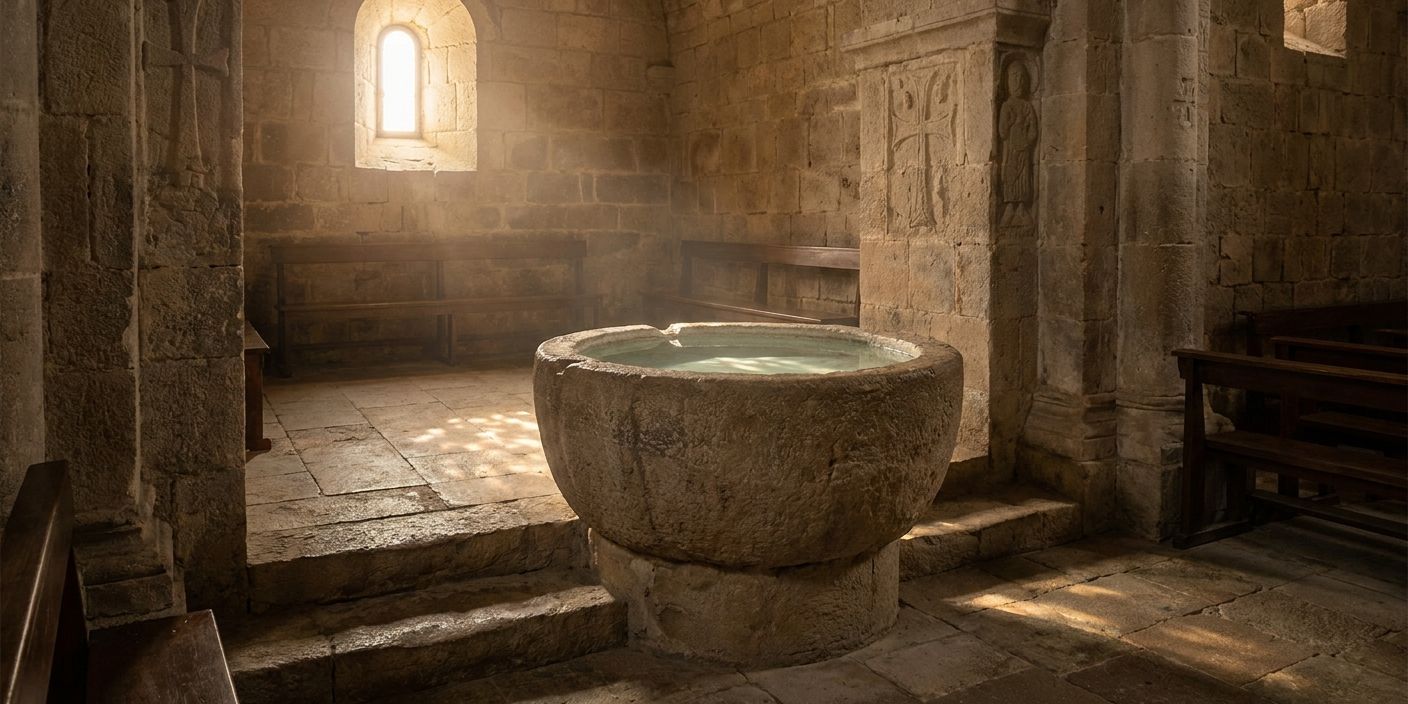

Long before Christians learned to recite the Apostles' Creed as a Sunday morning liturgical exercise, they spoke it as the defining moment of their initiation into the faith. The Creed was a baptismal confession — the public declaration of belief that candidates for baptism made as they stood in the water, turning from their old life and turning toward Christ. Understanding this original context transforms how we read and pray the Creed today.
Origins in Baptismal Interrogation
The earliest baptismal rites preserved in documents like the Didache (c. 100 AD) and Hippolytus's Apostolic Tradition (c. 215 AD) show that candidates for baptism were immersed three times and questioned at each immersion: Do you believe in God the Father Almighty? — immersion — Do you believe in Jesus Christ, the Son of God? — immersion — Do you believe in the Holy Spirit? The answers given by the candidate formed a kind of proto-creed that developed over time into the fuller statement we know as the Apostles' Creed.
The Roman Symbol and Regional Variants
By the third and fourth centuries, different regions had developed their own versions of the baptismal confession. The Roman Symbol — the Roman church's form of the Creed — is the direct ancestor of the Apostles' Creed as we know it. Candidates preparing for baptism at Easter would receive the Creed during catechesis, commit it to memory, and recite it publicly before their baptism in a ceremony called the redditio symboli. The Creed was considered so sacred that it was not written down but transmitted orally to prevent its misuse.
Mystagogy: Explaining the Creed After Baptism
In many ancient churches, the deep meaning of the Creed was not fully explained until after baptism — a practice called mystagogy. The newly baptized spent the week after Easter Sunday receiving extended teaching on the meaning of the Creed, the Lord's Prayer, and the sacraments they had just received. Cyril of Jerusalem's Catechetical Lectures are the best surviving example of this post-baptismal instruction, walking the neophytes through each article of the Creed with pastoral care and theological depth.
The Creed in Baptismal Practice Today
Many churches today retain the connection between the Apostles' Creed and baptism. The Lutheran, Anglican, Methodist, and Roman Catholic baptismal rites all include some form of credal interrogation — asking candidates or their parents and sponsors to confess the faith of the church in trinitarian terms before the water is applied. Even traditions that practice believer's baptism by immersion frequently read the Apostles' Creed as part of the service, connecting the individual's profession of faith to the faith of the whole church throughout history.
Why the Baptismal Context Matters
Recovering the baptismal context of the Apostles' Creed changes how we read it. It is not a checklist of abstract doctrines but a personal declaration: I believe. When ancient believers stepped into the baptismal waters and confessed the Creed, they were not merely agreeing to propositions — they were renouncing one allegiance and swearing another. They were dying and rising with Christ. Read in this light, the Apostles' Creed is one of the most dramatic texts in the Christian tradition — a covenant oath spoken at the threshold between an old life and a new one.


